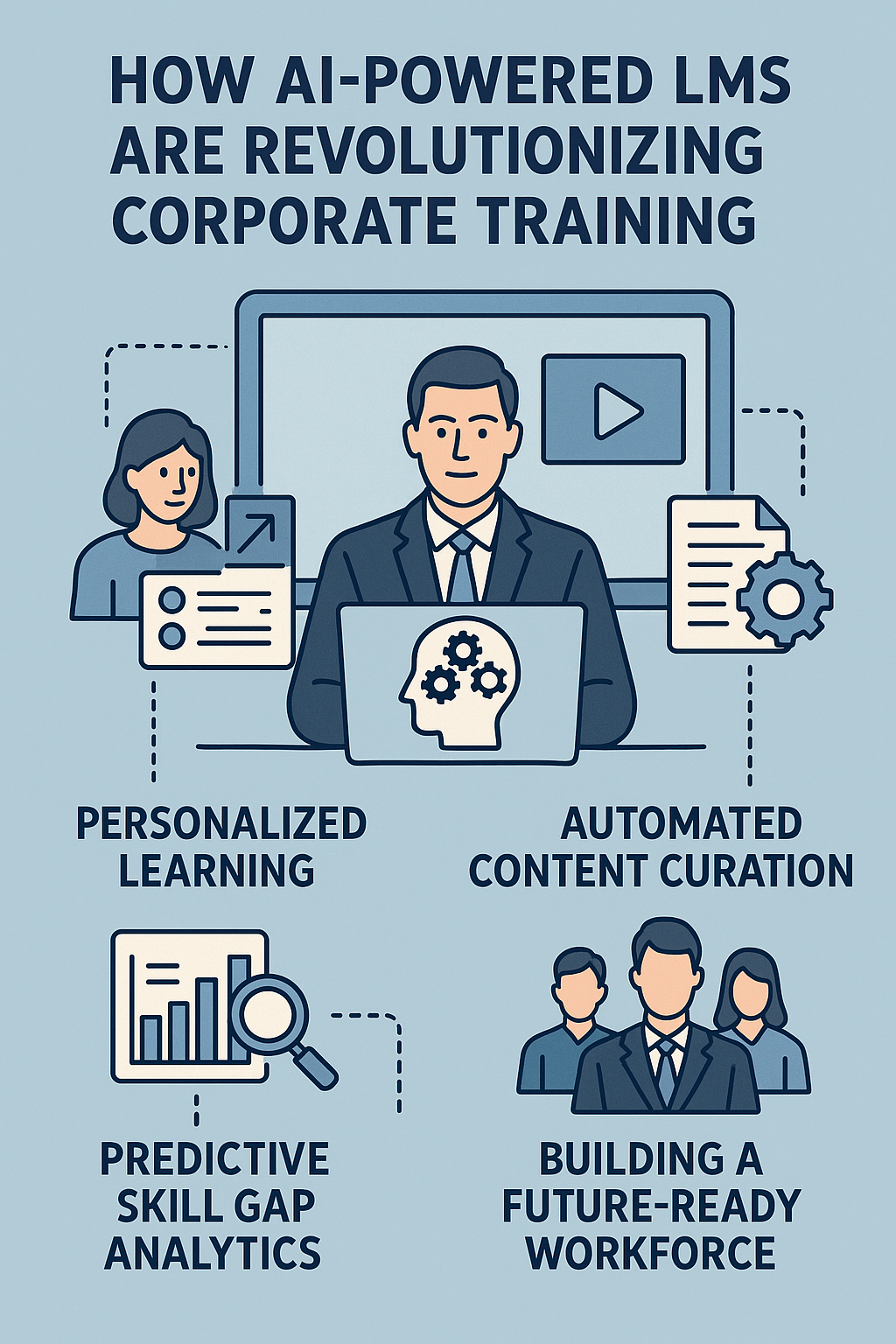
The AI-Powered LMS Revolution: Automating Skilling for Industry Innovation
Discover how AI-powered Learning Management Systems (LMS) are revolutionizing corporate training. This deep dive explores personalized learning, automated content curation, predictive skill gap analytics, and how these innovations are crucial for building a future-ready workforce and driving unparalleled industry advancements.
The AI-Powered LMS Revolution: Automating Skilling for Industry Innovation
In an era defined by relentless technological advancement and ever-shifting market demands, the need for a continuously evolving workforce has never been more critical. Businesses across every sector are grappling with the challenge of upskilling and reskilling their employees at an unprecedented pace. Traditional corporate training models, often static and one-size-fits-all, are struggling to keep up. Enter the AI-Powered LMS revolution – a transformative force that is not just enhancing learning but fundamentally redefining workforce development and igniting industry innovation.
This isn't merely an upgrade; it's a paradigm shift. By integrating Artificial Intelligence (AI) and intelligent automation for learning, Learning Management Systems (LMS) are evolving into dynamic, responsive platforms capable of anticipating needs, personalizing experiences, and ensuring that organizations possess the agility to thrive in a volatile future. The future of corporate training is here, and it's intelligent, adaptive, and automated.
The Core Mechanics of AI-Powered LMS: Orchestrating Next-Gen Learning
The true power of AI in LMS lies in its ability to move beyond simple content delivery to become an insightful, proactive partner in employee growth. Let's delve into the key mechanisms driving this transformation.
Personalized Learning Paths: The End of One-Size-Fits-All Training
One of the most significant breakthroughs of AI-driven education within an LMS is the ability to create truly personalized learning platforms. No two learners are identical; they possess different prior knowledge, learning styles, career aspirations, and paces of assimilation. AI algorithms analyze a vast array of data points to craft bespoke learning journeys:
- Individual Performance Data: AI assesses past course completions, assessment scores, and even on-the-job performance metrics to identify strengths and weaknesses.
- Learning Style Recognition: Through interactive quizzes and behavioral patterns within the platform, AI can infer whether a learner thrives with visual content, auditory explanations, hands-on exercises, or textual materials.
- Career Goals and Role Requirements: Integrating with HR systems, AI can align learning paths with an employee's current role, desired career trajectory, and the evolving skill requirements of the organization.
- Adaptive Content Delivery: Based on real-time progress, AI can dynamically adjust the difficulty, format, and sequence of content, offering remedial modules where needed or accelerating advanced learners through foundational material. This ensures optimal engagement and knowledge retention, making workforce development far more effective.
This level of personalization leads to increased learner engagement, faster skill acquisition, and a more relevant learning experience, making every training minute count.
Automated Content Curation and Creation: Always Relevant, Always Fresh
The digital content landscape is vast and constantly expanding. Keeping training materials current, relevant, and engaging is a monumental task for L&D teams. Here, eLearning automation powered by AI shines:
- Intelligent Content Curation: AI algorithms can continuously scan vast external databases – academic journals, industry reports, news articles, open-source courses – to identify the most relevant and up-to-date content pertaining to specific skills or topics. This ensures that training modules are always informed by the latest trends and best practices.
- Automated Content Generation: Beyond curation, advanced AI can assist in or even fully automate the creation of learning content. This includes generating summaries of long texts, drafting quiz questions, creating interactive simulations based on provided parameters, or even assembling micro-learning modules from existing resources. This dramatically reduces the burden on content developers and accelerates the deployment of new training programs, a critical factor for rapid industry innovation.
- Content Lifecycle Management: AI can flag outdated content, suggest revisions, or even automatically update modules with new information, ensuring the entire learning library remains fresh and accurate without constant manual oversight.
This automation guarantees that employees always have access to cutting-edge information, fostering a culture of continuous learning.
Predictive Analytics for Skill Gap Identification: Proactive Talent Management
Perhaps one of the most strategic applications of AI in LMS is its capacity for predictive analytics, especially concerning skill gap analysis. Traditional methods often identify skill gaps reactively – after a project fails, a new technology emerges, or a competitor gains an edge. AI changes this by:
- Analyzing Internal Data: By sifting through performance reviews, project outcomes, employee feedback, and even social collaboration data, AI can identify emerging skill deficiencies within teams or across the organization.
- Monitoring External Trends: AI tracks global market trends, technological shifts, competitor strategies, and job market demands to predict future skill requirements. It can alert organizations to skills that will soon become obsolete and those that will be in high demand.
- Proactive Skilling Recommendations: Based on these analyses, the LMS can automatically recommend targeted training programs to specific employees or departments, preemptively closing potential skill gaps before they impact productivity or industry innovation. This moves workforce development from a reactive cost center to a strategic competitive advantage.
This foresight allows companies to strategically invest in workforce development, ensuring they have the right talent with the right skills at the right time.
Intelligent Assessment and Feedback: Precision in Progress
AI also revolutionizes how learning is assessed and how feedback is delivered:
- Adaptive Assessments: Quizzes and exams can dynamically adjust difficulty based on a learner's responses, providing a more accurate measure of proficiency than static tests.
- Automated Grading and Feedback: AI can grade complex assignments, including essays and coding exercises, offering detailed, immediate, and consistent feedback. This speeds up the learning loop and frees instructors from tedious grading tasks.
- Performance Benchmarking: AI can benchmark individual and team performance against internal standards or industry best practices, identifying areas for improvement with high precision. This greatly enhances the efficacy of AI-driven education.
Enhanced Engagement and Support: Learning That Responds
Beyond content and assessment, AI contributes to a more engaging and supportive learning environment:
- AI Chatbots: These intelligent assistants provide instant answers to learner queries, offer technical support, and guide users through the platform, ensuring uninterrupted learning.
- Gamification and Motivation: AI can tailor gamified elements, such as challenges, leaderboards, and rewards, to individual preferences, boosting motivation and competition.
- Sentiment Analysis: By analyzing learner interactions and feedback, AI can gauge satisfaction and identify pain points, allowing L&D teams to refine courses and improve the overall learning experience.
Real-World Impact: Case Studies in Industry Innovation
To understand the profound impact of AI in LMS, let's consider a couple of hypothetical yet highly plausible scenarios reflecting current trends:
Case Study 1: Accelerating Product Cycles in High-Tech Manufacturing
A global electronics manufacturer faced a recurring challenge: the rapid obsolescence of its product lines demanded equally rapid upskilling of its engineering and production teams in new materials, software, and automation tools. Traditional classroom training was slow and costly. By implementing an AI-powered LMS, the company achieved a breakthrough.
The system used predictive analytics for skill gap identification, analyzing engineering project timelines, supplier roadmaps, and industry patents to forecast future skill needs six months in advance. It then automatically curated and recommended personalized learning paths for engineers, technicians, and even sales teams. For instance, when a new type of semiconductor material was introduced, the AI-driven platform immediately pushed tailored modules on its properties, handling, and integration to relevant personnel. The result? A 30% reduction in time-to-market for new products, a significant boost in product quality due to better-trained staff, and a notable increase in employee retention as individuals felt invested in their growth. This directly translated into unparalleled industry innovation and market leadership.
Case Study 2: Future-Proofing Healthcare Operations
A large hospital network struggled with the continuous need to train thousands of staff members on evolving medical protocols, new equipment, and compliance regulations. The sheer volume and dynamic nature of the information made it a logistical nightmare. Their adoption of an AI-driven education LMS transformed their workforce development strategy.
Through eLearning automation, the system automatically updated modules with the latest regulatory changes and clinical guidelines, ensuring compliance without manual intervention. Personalized learning platforms were created for different roles – nurses, doctors, administrative staff – focusing on their specific daily requirements. When a new diagnostic machine was installed, the LMS intelligently identified all staff needing training, prioritized based on their schedule and prior knowledge, and offered simulations and virtual reality modules. The system's skill gap analysis also identified potential areas of weakness in emergency response protocols before any real-world incidents occurred, allowing for proactive remedial training. The outcome was a significant improvement in patient safety, a more agile response to public health crises, and a highly competent, confident medical staff.
Conclusion: The Imperative for a Future-Ready Workforce
The integration of AI and automation into Learning Management Systems is not merely an optional enhancement; it is a fundamental requirement for businesses aiming to build and sustain a competitive edge in the 21st century. The AI-Powered LMS revolution enables organizations to move beyond reactive training to proactive, strategic workforce development.
By delivering personalized learning platforms, automating content curation, providing insightful skill gap analysis through predictive analytics, and enhancing engagement, these systems create a culture of continuous learning that is both efficient and highly effective. They empower employees to acquire the right skills at the right time, fostering adaptability and resilience across the entire organization. This proactive approach to future of corporate training isn't just about individual growth; it's the bedrock for sustained industry innovation and long-term success.
As industries continue to evolve at breakneck speed, companies that embrace AI in LMS will be the ones best equipped to navigate change, seize new opportunities, and ultimately, lead their respective fields into the future. The question is no longer if your organization will adopt AI for learning, but when.
Ready to Transform Your Workforce?
Is your organization prepared to harness the power of AI in LMS to build a truly future-ready workforce? Explore how personalized learning platforms and intelligent automation for learning can drive your next wave of industry innovation. Contact us today for a consultation and discover how an AI-powered LMS can revolutionize your workforce development strategy.